When less treatment may be the right treatment
De-escalation sounds scary to anyone who’s going through or has been through breast cancer. So why is the oncological world using the term? It sounds like care is being reduced – full-stop. The reality, however, is just the opposite – but also increasingly complex.
In breast cancer, the aim is to look at two types of information;
– the evidence building up from recent clinical trials as to when a treatment might not be effective for some people;
– better information becoming available on the individual patient’s needs.
De-escalation asks whether all this information can help clinicians identify when a less intensive treatment pathway is appropriate, without losing the cancer control that matters to patients.
Why the word can feel alarming
For many people, a breast cancer diagnosis creates an understandable instinct to do everything possible. More treatment for most patients feels safer – as if the more treatment we throw at it, the greater the chance of getting through it. The word de-escalation sounds as if care is being withdrawn, or that someone is being offered less because of pressure on services.
That is not the purpose of planned treatment de-escalation. It is an evidence-led approach that asks whether some people, can safely avoid treatment that is unlikely to add meaningful benefit. What de-escalation is about is using all the evidence from clinical research and the patient themselves to identify the optimum treatment regime and to give the right amount of treatment – no more, no less – to achieve the best results.
This is different from stopping, pausing or changing treatment because the side effects are too difficult to manage. A change made because someone is not tolerating treatment is an individual clinical decision.
Planned de-escalation is based on research evidence, better access to detailed information on tumour stage and size, tumour biology and biomarkers, response to neoadjuvant therapy, lymph node status as well as the patient’s age, general health and preferences.
Let’s look at a couple of examples of recent clinical research;
OPTIMA: what the first results showed
The first results from the phase III OPTIMA trial have brought de-escalation into public discussion. OPTIMA was designed to test whether a tumour gene expression test could guide chemotherapy decisions for people with early breast cancer who would traditionally be considered at higher clinical risk.[1,2]
The trial enrolled 4,429 women and men aged 40 or older with hormone-sensitive, HER2-negative early breast cancer. Most participants had cancer spread to nearby lymph nodes, which would usually make chemotherapy part of the standard discussion after surgery.[1]
Participants were randomly assigned to standard treatment, with chemotherapy followed by hormone therapy, or to a test-directed pathway using the Prosigna tumour profiling test. In the test-directed group, those with a low risk of recurrence score received hormone therapy without chemotherapy. Radiotherapy and other treatment were given as usual in both groups.[1]
More than two thirds of participants, 68%, had a low Prosigna score.[1,3] Among this low score group, five years after treatment, 95% of those who received chemotherapy plus hormone therapy were alive and free from breast cancer recurrence. The corresponding figure for those treated with hormone therapy alone was 94% in the UCL reporting of the trial.[1]
These results do not mean chemotherapy is unnecessary for everyone with hormone-sensitive breast cancer. They show that, in the population studied, additional tumour biology information helped identify many people for whom chemotherapy appeared to add little or no extra benefit.
They also show why de-escalation should never be framed as simply doing less. In OPTIMA, clinicians were not relying only on traditional features such as tumour size and lymph node involvement. They were adding biological information from the tumour itself to refine the decision.
More information is changing the question
Historically, treatment decisions have drawn on information such as tumour size, grade, lymph node involvement, hormone receptor status, HER2 status, menopausal status, age, other health conditions and patient preference. These remain essential.
What is changing is the amount and type of information that can now be considered. Tumour profiling can help estimate recurrence risk and likely treatment benefit in specific settings. Pathology continues to become more detailed. Imaging can help define disease extent and response. Blood-based approaches are being studied for signals of molecular change before those changes are visible on scans or symptoms are present.
This does not make treatment decisions automatic. It makes them more evidence-dependent. The more information clinicians use, the more important it becomes to know exactly what has been validated, in which patient group and for which decision.
Emerging biomarker and monitoring approaches
Biomarkers are often discussed as though they are a single category. In practice, different biomarkers answer different questions.
A tumour gene expression test, such as the test used in OPTIMA, is performed on tumour tissue and can help estimate risk or likely benefit from chemotherapy in a defined early breast cancer setting.[1,2]
Circulating tumour DNA, or ctDNA, is a blood-based signal made up of fragments of tumour-derived DNA. In breast cancer research, ctDNA is being investigated for minimal residual disease, treatment response, early signs of recurrence and emerging resistance.[4,5]
At ESMO Breast Cancer 2026 in Berlin, discussion of ctDNA surveillance in early breast cancer was cautious. Commentary on the TRAK-ER study noted that ctDNA prevalence can be very low in early-stage disease and that many positive cases still need to be interpreted alongside clinical and radiological findings.[5]
In stage 4 breast cancer, ctDNA monitoring is also being studied as a way to detect resistance mechanisms earlier. Reports from Institut Curie describe trials in hormone-dependent stage 4 breast cancer where detection of ESR1 mutations in blood was used to guide endocrine therapy before clinical progression was apparent.[6]
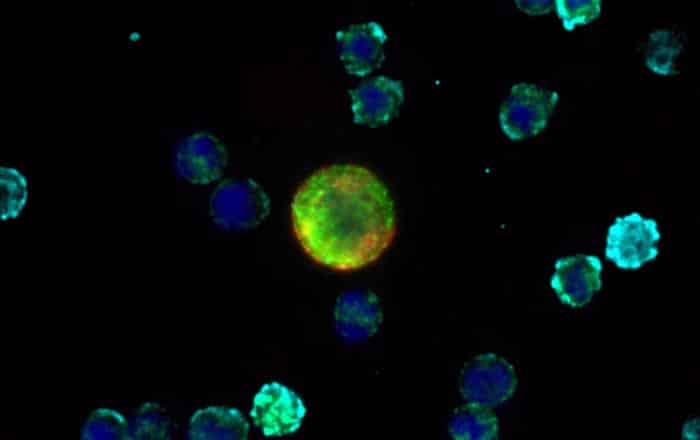
Circulating tumour cells, or CTCs, are different. They are intact cancer cells found in the bloodstream. Because they are whole cells, researchers can study features such as phenotype, morphology and cell-to-cell heterogeneity – tiny differences in cells of the same type. ESMO reporting in 2026 noted that integrating multiple vehicles, including CTCs, ctDNA and tissue biopsies, may provide a more holistic view of a person’s disease. The same discussion also stressed that not all biomarkers have clinical utility and that rigorous evidence is essential.[7]
This is directly relevant to Frontier Diagnostics. We are developing Sentinel qCTC™, an investigational technology platform intended to explore the characterisation of intact circulating tumour cells. Our developmental work does not currently support any claim that Sentinel qCTC™ can guide de-escalation, monitor treatment response or inform clinical decisions.
Monitoring is not the same as acting
A biomarker may show that risk is higher, that a signal is falling, or that a resistance mutation has appeared. The next question is harder: does acting on that information improve outcomes?
That is why the difference between prognostic, predictive and monitoring information matters. A prognostic marker provides information about likely outcome. A predictive marker provides information about likely benefit from a specific treatment. A monitoring marker follows change over time. A marker can be useful in one role and not yet validated in another.
For de-escalation, the standard must be especially high. If a test is used to support less intensive treatment, patients and clinicians need confidence that the decision has been tested in the right population and that the outcomes are acceptable.
OPTIMA is powerful because it tested a decision pathway prospectively in a large randomised trial. Emerging liquid biopsy approaches are promising, but many still need prospective evidence showing not only that they detect change, but that treatment decisions based on those changes improve patient outcomes.
De-escalation is broader than chemotherapy
Chemotherapy is only one part of the de-escalation discussion. Breast cancer research also asks whether some people can avoid or reduce radiotherapy, undergo less extensive surgery, or tailor the length and intensity of longer-term endocrine treatment.
The PRIME II trial studied omission of radiotherapy after breast-conserving surgery in women aged 65 or older with selected low risk, hormone receptor-positive early breast cancer who were receiving endocrine therapy. At ten years, omitting radiotherapy increased the risk of local recurrence but did not change overall survival in the trial population.[8]
The INSEMA trial studied whether sentinel lymph node surgery could be omitted in selected people with clinically node-negative early breast cancer. The primary results reported non-inferior invasive disease-free survival in the trial population and fewer arm-related complications such as lymphoedema, with omission of axillary surgery.[9]
Endocrine treatment raises a different type of question. For some people, hormone therapy continues for up to ten years. NICE guidance emphasises discussion of benefits, risks and side effects, with decisions shaped by recurrence risk, menopausal status, tolerance and patient preference.[10]
Each example has a different evidence base. A result from one age group, subtype or treatment setting cannot be applied to another without appropriate validation.
Equity matters in doing less safely
De-escalation can reduce treatment burden, but only if the information needed to make the decision is available. Access to tumour profiling, specialist pathology, imaging and clear patient communication may vary between health systems and communities.
This is why de-escalation belongs within our broader July theme of democratisation. A more personalised pathway should not be available only to people closest to specialist centres or research-active hospitals.
The aim should be evidence-based personalisation that can travel beyond the most advantaged settings. That means validated tests, transparent criteria, trusted communication and systems that can support informed decisions for more people.
The right treatment, for the right person
De-escalation is not about treating breast cancer less seriously. It is about using the rapidly improving evidence-base to avoid unnecessary burden when additional treatment is unlikely to help.
The OPTIMA results show what this can look like when a clinical question, a tumour profiling test and a treatment decision are brought together in a large trial. Emerging biomarker and monitoring approaches point to a future where information may become more dynamic, drawing on tissue, blood, imaging and clinical context.
That future must be built carefully. More data is not automatically better care. Better care depends on asking the right question, using the right test, in the right population, and proving that acting on the result helps patients.
At Frontier Diagnostics, our long-term vision is to help democratise real-time cancer diagnostics for everyone, everywhere. Our current work remains at an early developmental stage. We believe the direction of travel is clear: more individualised information can support more confident decisions, including decisions about when more treatment is needed and when less may be enough.
Website regulatory statement
Sentinel qCTC™ is an investigational technology platform undergoing development at Frontier Diagnostics Ltd. The platform has not reached design freeze and has not been submitted for regulatory review under IVDR (EU) 2017/746, UK MDR 2002, or FDA 21 CFR Part 809. It is not approved, cleared, or validated for diagnostic, clinical, or commercial research use. All scientific content relating to Sentinel qCTC™ describes developmental aims and does not constitute performance claims.
Sources
[1] University College London. Gene test can safely spare many breast cancer patients from chemotherapy. 29 May 2026. Accessed 29 June 2026.
[2] Stein RC, et al. First results from the OPTIMA phase III randomised non-inferiority trial of test-directed chemotherapy in patients with high clinical risk ER-positive HER2-negative early breast cancer. Journal of Clinical Oncology. 2026;44(16_suppl):500.
[3] The ASCO Post. Phase III trial shows noninferiority for test-guided chemotherapy decisions in early breast cancer. June 2026. Accessed 29 June 2026.
[4] Egle D, et al. Long-term prognostic value of ctDNA in early breast cancer: insights from the neoadjuvant ABCSG-34 trial. npj Breast Cancer. 2026;12:77.
[5] ESMO Daily Reporter. The role of ctDNA surveillance is still uncertain in early breast cancer. ESMO Breast Cancer 2026. Accessed 29 June 2026.
[6] Institut Curie. Breast cancer: further evidence supporting the clinical use of circulating biomarkers. 3 June 2026. Accessed 29 June 2026.
[7] ESMO Daily Reporter. Liquid biopsy: improving outcomes throughout breast cancer care. ESMO Breast Cancer 2026. Accessed 29 June 2026.
[8] Kunkler IH, et al. Breast-conserving surgery with or without irradiation in early breast cancer. New England Journal of Medicine. 2023; 388:585-594.
[9] Reimer T, et al. Axillary surgery in breast cancer, primary results of the INSEMA trial. New England Journal of Medicine. 2025; 392:1051-1064.
[10] National Institute for Health and Care Excellence. Early and locally advanced breast cancer: diagnosis and management. NICE guideline NG101. Updated 2025. Accessed 29 June 2026.