
Progress rarely replaces previous knowledge. It builds on it.
Over the past two decades, our understanding of breast cancer has changed dramatically. What was once considered a single disease is now recognised as a collection of biologically distinct conditions, each with its own characteristics, behaviour and response to treatment. Every advance has revealed greater complexity, but that complexity has also created new opportunities for more personalised care.
As our understanding has evolved, so too have the questions researchers and clinicians ask.
Twenty years ago, the question was often, What type of breast cancer is this? Today, it is equally important to ask, What is this tumour doing now? How is it changing? Why does one patient respond differently from another? These questions reflect a shift from describing cancer to understanding its biology in real time.
This evolution is central to precision oncology.
Precision oncology is often associated with targeted therapies or genomic testing, but its broader goal is much simpler: to provide the right treatment for the right patient at the right time. Achieving that goal depends on understanding the biological signals that matter most at each stage of the cancer journey.
No single test can answer every question. Histopathology transformed cancer diagnosis by allowing tumours to be examined at the cellular level. Immunohistochemistry enabled more accurate tumour classification through hormone receptor and HER2 testing. Genomic profiling added another dimension by identifying molecular level alterations that influence prognosis and treatment selection. Together, these advances have become central to modern breast cancer management and are reflected in current international clinical guidelines.[1,2]
More recently, liquid biopsy has introduced the possibility of assessing tumour biology through a blood sample. Rather than replacing tissue biopsy, liquid biopsy offers an opportunity to complement established diagnostic approaches while enabling biological information to be collected over time.
Importantly, liquid biopsy is not a single technology.
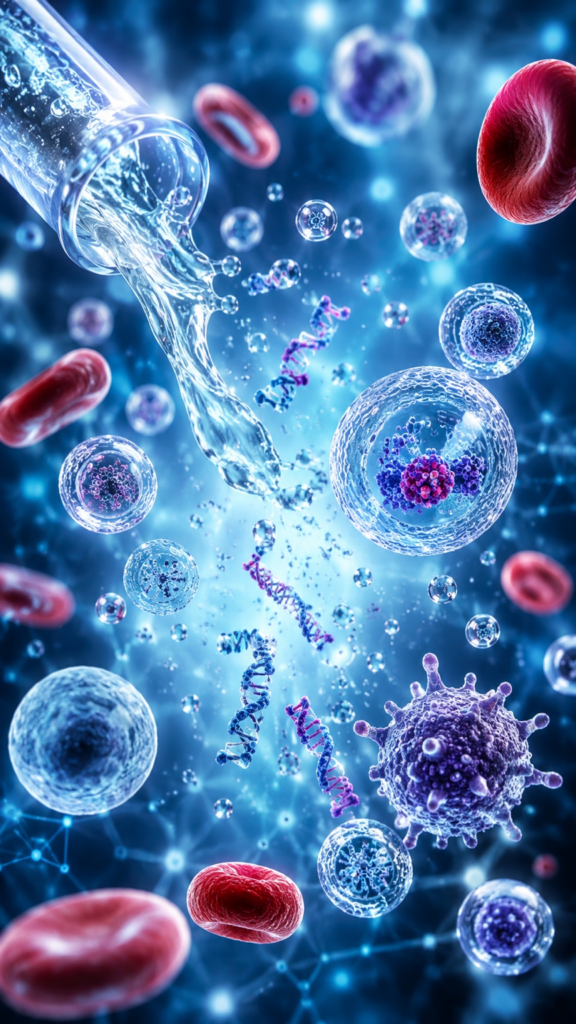
Circulating tumour DNA (ctDNA) consists of fragments of tumour-derived DNA released into the bloodstream and can provide information about genetic alterations. Circulating tumour cells (CTCs), by contrast, are intact cancer cells that have entered the circulation from a primary or metastatic tumour. Because they remain whole cells, CTCs may offer opportunities to investigate cellular characteristics, protein expression and tumour biology which complement ctDNA analysis.
This distinction highlights an important principle in precision oncology. Different technologies answer different biological questions.
Current evidence suggests that no individual biomarker can provide a complete picture of a patient’s disease. Instead, imaging, tissue pathology, genomic analysis, ctDNA and CTCs each contribute complementary information. Choosing the most appropriate mix of tools depends on the biological questions being asked.
This increasingly nuanced view is reflected in recent clinical guidance. The American Society of Clinical Oncology (ASCO) recognises the potential of circulating tumour DNA while emphasising that evidence supporting routine clinical implementation continues to evolve. Similarly, discussions at the 2026 ESMO Breast Cancer Congress highlighted the growing role of liquid biopsy across the breast cancer pathway, alongside the importance of rigorous validation for emerging biomarkers. [3,4]
As breast cancer treatment becomes more personalised, understanding tumour biology throughout the disease journey is becoming increasingly important. Tumours evolve. Treatments exert selective pressures. Metastases may develop distinct biological characteristics. These changes mean that the information needed at diagnosis may not always be the information needed months or years later.
This is where newer technologies are beginning to ask different questions.
Research into circulating tumour cells, for example, is exploring whether analysing intact cells may provide insights into tumour heterogeneity, treatment response and disease progression beyond genomic information alone. Although this work remains an active area of investigation, it reflects a broader trend across cancer research: recognising that understanding biology requires multiple complementary sources of evidence rather than a single definitive test.[5]
At Frontier, this principle underpins our developing work; to investigate circulating tumour cell technology as a means of supporting future research into tumour biology and disease monitoring. Our work is not CE-IVDR marked, UKCA approved, or FDA cleared and not available for clinical or commercial use. Like all emerging biomarker technologies, its potential must be established through robust scientific evidence before any future clinical application may be considered.
The history of breast cancer research shows that progress has rarely come from finding one perfect answer. Instead, each scientific advance has enabled researchers to ask better questions, revealing new layers of biological complexity and creating opportunities for more informed clinical decision making.
Precision oncology is not simply about developing new technologies. It is about understanding which questions those technologies are best placed to answer. As research continues, the greatest advances are likely to come not from relying on a single biomarker, but from combining multiple sources of biological information to build a more complete understanding of each patient’s disease.
Website disclaimer
Frontier Diagnostics’ technology platform currently in development. It is not CE-IVDR marked, UKCA approved, or FDA cleared. It is not available for clinical or commercial use. For research collaboration enquiries only.
Sources
1. Loibl S, Andre F, Bachelot T, Barrios C H et al. Early breast cancer: ESMO Clinical Practice Guideline for diagnosis, treatment and follow-up. Annals of Oncology.
2024
2. National Institute for Health and Care Excellence (NICE). Early and locally advanced breast cancer: diagnosis and management (NG101).
3. American Society of Clinical Oncology (ASCO). Circulating Tumour DNA Testing in Solid Tumours and Lymphoma: ASCO Guideline. 2026.
4. ESMO Breast Cancer Congress 2026. Liquid biopsy across the breast cancer spectrum.
5. Thomas-Bonafos T, et al. Emerging roles of circulating tumour cells in breast cancer research. npj Breast Cancer. 2024.