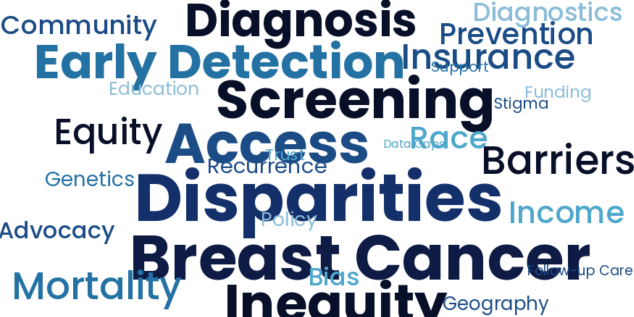

July is Ethnic Minority Cancer Awareness Month – so it is timely to review why this is so important. The breast cancer statistics from bone fide sources must tell the story accurately – or do they? Breast cancer is not one story. A more equitable future begins by recognising the differences that headline figures can hide.
• Are more people diagnosed early?
• Are screening and diagnostic services reaching communities with lower participation?
• Are diverse populations represented in research?
• Can new approaches support better-informed decisions across the full breast cancer care continuum?
• And will innovation be accessible beyond a small number of specialist centres?
Progress should therefore be measured in more than national averages. It should also be measured by whether gaps are narrowing.
The scale of breast cancer is significant, but scale alone does not explain the challenge. Breast cancer varies biologically. It is diagnosed at different stages. It affects women and men, younger and older people, and communities with different experiences of healthcare.
A clearer measure of progress
For us, democratisation means considering accessibility, representation and real-world use from the beginning. Innovation should not be designed only for people who already have the easiest access to specialist care. At Frontier Diagnostics, our vision is to democratise real-time cancer diagnostics for everyone, everywhere. We are developing Sentinel qCTC™, an investigational technology platform intended to explore the characterisation of intact circulating tumour cells. This work remains at an early developmental stage. No claims are made about clinical performance or utility.
Diagnostics and monitoring are central to this discussion. Decisions across breast cancer care depend on reliable information about the disease and how it may be changing. The long-term promise of biomarker-led approaches is to support decisions that are increasingly aligned with the biology of an individual cancer.
At the ESMO Asia Congress, December 2025, it was emphasised that population diversity in cancer treatment matters, because gaps in clinical, pathological and genetic data can contribute to unequal access to genomic testing, liquid biopsies, clinical trials and tailored treatment.[11]
It should also recognise that people reach diagnosis through different routes and may need different forms of information and support. It means asking who participates in screening, who is diagnosed early, whose cancer is fully characterised, who is represented in research and who benefits from advances in care.
Precision oncology is often described as matching treatment to the characteristics of a person’s cancer. That is an important part of personalised care, but personalisation should extend beyond selecting treatment options.
Personalisation must include equity
These findings should not be reduced to a single explanation or attributed to ethnicity itself. Biology, social conditions and healthcare systems interact. The important question is whether every person can reach diagnosis, specialist assessment and appropriate treatment without avoidable barriers.
Deprivation also shapes outcomes. English studies have reported that women from more deprived groups are more likely to be diagnosed at a later stage and can experience higher breast cancer mortality, even within a screened population.[9,10]
Research using English cancer registration data found that ethnic minority women were more likely to have breast cancers with less favourable characteristics, even after accounting for age and other factors.[7] Other studies have shown that differences in survival can be partly explained by socioeconomic circumstances, stage at diagnosis and tumour biology.[8] Breast cancer incidence varies between ethnic groups in England, but lower incidence does not necessarily mean an equal or better experience after diagnosis. Large population studies have found differences in age at presentation, tumour characteristics, stage and survival between ethnic groups.[6,7,8]
Different communities can face different outcomes
The reasons are rarely simple. They can include awareness, language, fear, practical barriers, trust in healthcare, competing responsibilities and previous experiences of services. Improving participation therefore requires more than sending the same invitation to everyone. It requires communication and services that respond to the communities they are intended to reach. Screening can help detect breast cancer before symptoms develop. However, equal availability does not always lead to equal participation. Research in England has identified lower breast screening uptake in more deprived communities and among some ethnic minority groups.[4,5]
The stage at which breast cancer is diagnosed remains one of the strongest influences on outlook. Population data from England shows a steep survival gradient between early-stage and stage 4 disease.[3] These statistics describe groups, not individuals, but they demonstrate why timely diagnosis and access to appropriate care matter.
Stage at diagnosis changes the picture
Some breast cancers grow slowly. Others are more aggressive. Some respond to endocrine therapy or HER2-targeted treatment. Triple-negative breast cancer may require a different approach. A single average can never describe all these experiences. Progress also needs context. Breast cancer is not one disease with one predictable course. It includes biologically distinct subtypes, defined in part by hormone receptor and HER2 status, with different patterns of behaviour and different treatment pathways. Current ESMO guidance reflects this complexity by recommending that diagnosis and treatment decisions are informed by tumour biology, disease extent, individual health and patient preferences.[2]
Breast cancer research, screening and treatment have changed many lives. Survival has improved substantially over recent decades. Yet the scale of the disease remains significant, with almost 60,000 people diagnosed in the UK each year.[1]
Progress, but not the same progress for everyone
Breast cancer is the most commonly diagnosed cancer in the UK, but headline figures can hide important differences in biology, stage at diagnosis, treatment and outcomes. Understanding those differences is essential if progress is to reach everyone to enable equitable access to diagnosis, treatment, monitoring, and outcomes. This is especially relevant because July is Ethnic Minority Cancer Awareness Month which links directly to our vision of democratising real-time diagnostics and care.
Sentinel qCTC™ is an investigational technology platform undergoing development at Frontier Diagnostics Ltd. The platform has not reached design freeze and has not been submitted for regulatory review under IVDR (EU) 2017/746, UK MDR 2002, or FDA 21 CFR Part 809. It is not approved, cleared, or validated for diagnostic, clinical, or commercial research use. All scientific content relating to Sentinel qCTC™ describes developmental aims and does not constitute performance claims.
Sources:
1. Cancer Research UK
2. ESMO Clinical Practice Guidelines
3. ONS and NCRAS
4. Jack RH, Møller H, Robson T, Davies EA. Breast cancer screening uptake among women from different ethnic groups in London: a population-based cohort study. BMJ Open. 2014;4:e005586. doi:10.1136/bmjopen-2014-005586.
5. UK Health Security Agency. Breast screening: identifying inequalities. Updated 27 September 2024.
6. Jack RH, Davies EA, Møller H. Breast cancer incidence, stage, treatment and survival in ethnic groups in South East England. British Journal of Cancer. 2009;100:545–550.
7. Gathani T, Ali R, Balkwill A, et al. Ethnicity and the tumour characteristics of invasive breast cancer in over 116,500 women in England. British Journal of Cancer. 2021;125:611–617.
8. Møller H, Henson K, Lüchtenborg M, et al. Short-term breast cancer survival in relation to ethnicity, stage, grade and receptor status: national cohort study in England. British Journal of Cancer. 2016;115:1408–1415.
9. Lyratzopoulos G, Abel GA, Brown CH, et al. Socio-demographic inequalities in stage of cancer diagnosis. Annals of Oncology. 2013;
10. Morris M, Woods LM, Rachet B. What might explain deprivation-specific differences in the excess hazard of breast cancer death among screen-detected women? Cancer Epidemiology. 2016;43:72–80.
11. European Society for Medical Oncology. Population diversity in cancer treatment: differences matter. ESMO Daily Reporter, ESMO Asia Congress 2025. Published 6 December 2025.